

We’re still processing all of the wonderful events of the 45th anniversary weekend – a reflection will come soon! In the meantime, please enjoy the following article, written by Dr. J. Keith Hyde, appeared in the local newspaper, Opasquia Times, on Wednesday, August 20, 2025. Thanks Keith for letting people know about our event!
On August 22-24, 2025, the Henry Budd College for Ministry (HBCM) will celebrate its 45th anniversary. The College is named after the Rev. Henry Budd, Sr. [1812-1875], one of the first Indigenous men to be ordained by the Anglican Church in North America. Budd was born in Norway House and educated at the first western school started in the Red River Settlement in 1820. He arrived by canoe with his wife, children, and mother at “Paskoyac” in June, 1840, spending the next 35 years working hard to establish mission stations at The Pas/ OCN, Moose Lake, and Nepowewin (SK). The hallmarks of his life’s work included his unwavering hospitality, passion for teaching Cree reading and writing, commitment to establishing family evening prayers in parishioners’ homes, and love for following Jesus.
The College is located in a grand 100-year-old house at 403 Larose Avenue in The Pas. The property was originally purchased in 1958 as the mother house for the Bishop’s Messengers, a community of Anglican sisters who primarily served in education and health care. The basement still contains the cozy St. Faith’s Chapel where they gathered regularly for prayers. Following the ordination of women in the Anglican Church in 1976, the Bishop’s Messengers were disbanded in 1979.
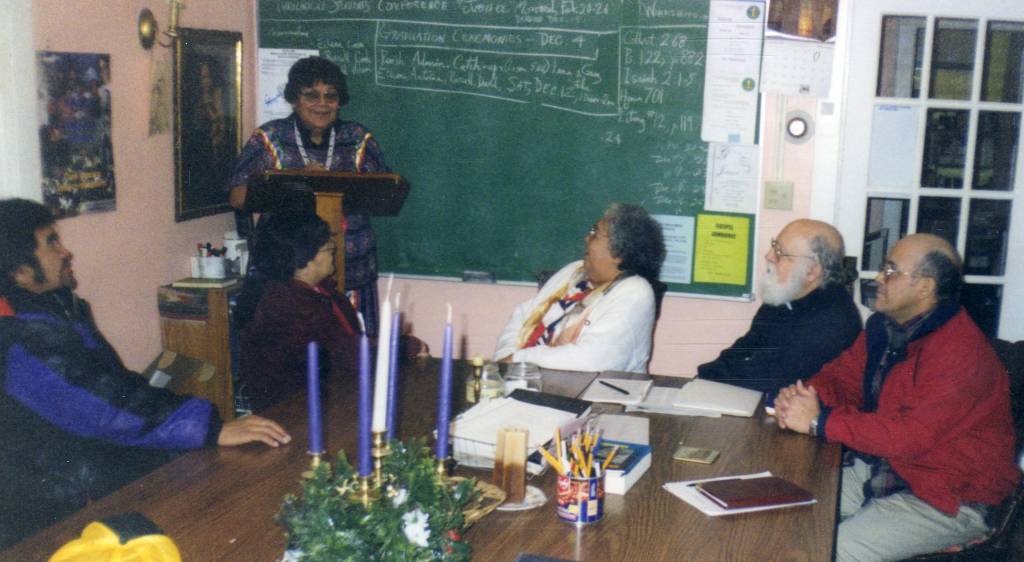
Initiated by Bishop John Conlin, Diocese of Brandon, the Henry Budd Christian Training Centre officially opened its doors on September 20, 1980. In 1991, Its name was changed to Henry Budd College for Ministry, according to co-director Alyson Barnett-Cowan, “to reflect what it truly was and did, rather than sounding like a technical school.” Establishing a local college for ministry training acknowledged how commitment to family, responsibility to community, and financial restrictions prevented many First Nations people from studying at seminaries in the south. Furthermore, HBCM provided opportunities for people to express the teachings of Jesus within their own unique Cree, Métis, and northern cultures and contexts. The College’s emblem reflects these realities. A green circle encloses the footprints of followers travelling together around teepees pointing in the four directions, which face an inner circle filled with hearts—the divine “Love which dances at the heart of things” (Malcolm Guite, poet). In addition to St. Faith’s Chapel, the College contains one main classroom and reference library, an office for the resident Elder, the Ven. Lydia Constant who famously proclaimed in 1984, “I’m just coming for this one class; I’m not committing to anything!”, the coordinator’s office, a newly renovated upstairs apartment for visiting guests, and a kitchen for preparing coffee, tea, meals, and biscuits to refresh students and visitors alike—Henry Budd would have approved!

During its history, 35 students from HBCM have been ordained, most of whom are Indigenous and have served northern communities. Through a partnership with the Vancouver School of Theology (VST), many students have travelled to BC in summer to attend courses at the Indigenous Studies Program, currently under Director Rev. Dr. Ray Aldred, a Cree member from Swan River Band, AB, Treaty 8. The College provides three levels of training for both Indigenous and non-Indigenous students: Lay education for spiritual and ministry growth, a Diploma for Ministry, and a Master’s of Divinity through VST. Courses are very conversational, providing opportunities for storytelling, personal reflection, dialogue, and application within northern and Indigenous communities. Course titles include Foundations of Lay Ministry, Cree Hymn Singing, Biblical Theology, Mending the Broken Hoop, and dozens of others. With the benefits of Zoom, the College has welcomed students from as far away as Kamloops, Whitehorse, and Moosonee.
As well as offering classes, the College has also served as a centre for developing user-friendly resources, particularly for equipping smaller congregations without full-time priests that are led by lay leaders. Free online resources include instructions for wakes, funerals, and memorials, weddings and marriages, baptismal preparation and services, confirmations, Eucharist, and healing services, This weekend’s celebrations are an opportunity to share teachings, memories, music, and food, and to acknowledge the work of past and present students and staff. Many of HBCM’s graduates are familiar to people across the north, including current and past priests and leaders from Opaskwayak Cree Nation, Chemawawin Cree Nation, Mosakahiken Cree Nation, Misapawistik Cree Nation, Sapotaweyak Cree Nation, Wuskwi Sipihk First Nation, Cormorant, The Pas, Flin Flon, Snow Lake, Wabowden, and Thompson. Past directors and coordinators include the Rev. Beverly Chapman (1980-1983), the Revs. Alyson and Bruce Barnett-Cowan (1983-1991), the Rev. Canon Fletcher Stewart (1991-2004), Marion Jenkins and the Rev. Paul Sodtke (2004-2016), and the Ven. Dr. Kara Mandryk (2016-).
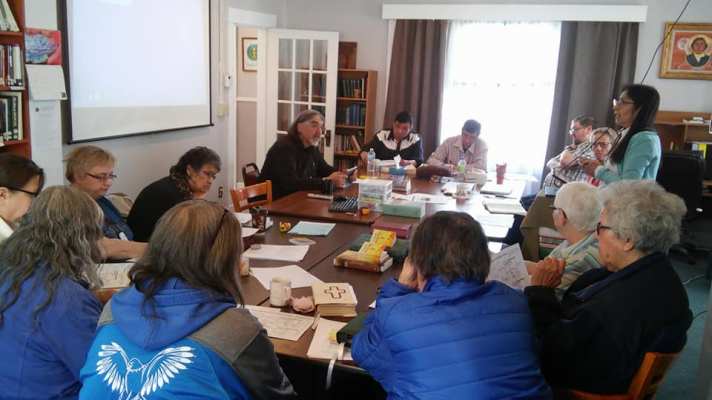
During his 25 years as Church Missionary Society worker, the Rev. Henry Budd wrote over 500 pages of journals and letters chronicling his work among the Swampy and Plains Cree. For two evenings a week, the busy priest, schoolteacher, and farming/ fishery/firewood coordinator joined various households in their family prayer times. One British editor marveled at the participation of nearly every community member in “the habit of family prayer”, remarking “Of what English village, favoured as it may have been for many years with the loving ministrations of the most devoted pastor, could such witness be borne […]?” Over 130 years later, reflecting on the question, ‘Is it worth it?”, coordinators Paul Sodke and Marion Jenkins wrote in 2005, “The College has empowered individuals and Christian communities in the various First Nations to find their own voice and chart their own ways forward and that, indeed, is worth it.” Come out and help us celebrate the ongoing challenges and rewards of the College’s 45-year legacy of bringing practical and contextual Christian training into people’s homes and communities throughout northern Manitoba and beyond.

 Henry Budd College for Ministry